New York, NY
Borough of Manhattan Community College,
City University of New York
30,400 sf
File this project under “Urgent.” In the aftermath of 9/11, the Borough of Manhattan Community College, just north of Ground Zero, lost a building when a Trade Center tower collapsed into it … but it also lost use of its premises, co-opted for emergency government services. Without classroom space, BMCC faced the possibility of losing its students and faculty.
Plunged into creating a viable temporary campus, the City University, Dormitory Authority of the State of New York (DASNY), Helpern Architects, and a string of committed consultants and contractors helped BMCC swing from emergency to site selection, to creating a “trailer campus” on the City College of New York Upper Manhattan campus.
The team eclipsed standard procedures, researched and resolved site conditions and conflicts, and developed a fully-functioning educational facility … in four months! David Helpern observed that “We strongly believe in preparation and planning – not possible here. In the case of BMCC’s temporary campus, spirit, generosity, professionalism, plus momentum equaled achievement.”
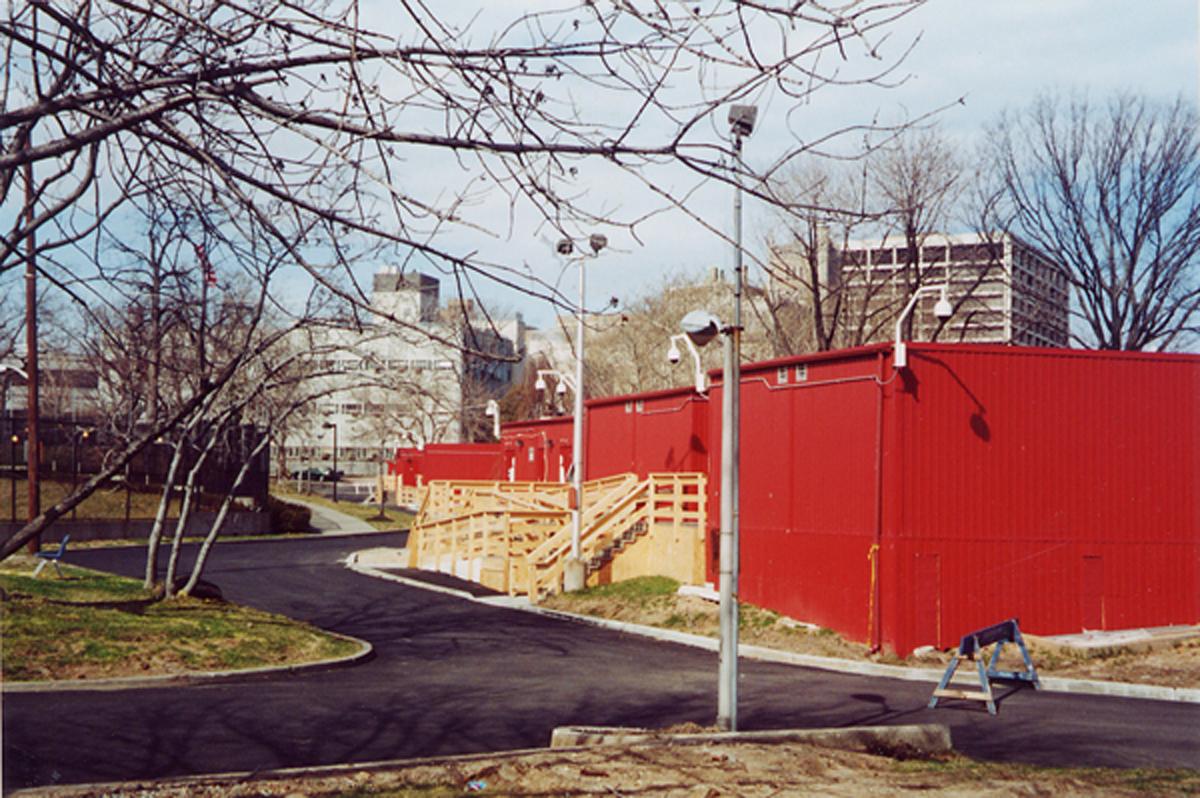
By the winter semester, right on schedule, a new campus emerged on the rolling site [two CCNY parking lots], assembled from 23 red modular classroom units resting on 835 newly-poured Sonatube piers, connected by 14,000 sf of decks and ramps. The temporary installation, mostly computer classrooms, served 840 students and faculty.
Helpern’s offices, located in the restricted zone, were opened to its employees. With the official role to do the master plan and design, we prepared the site survey and preliminary zoning analysis, and monitored manufacturing, construction, and installation. A Helpern representative was at the site seven days a week to resolve construction and design issues.
Helpern’s project manager ran project meetings, which included up to 35 senior people empowered to sign off and expedite actions. Direct communication with agency heads sped up the process, including permit negotiations with the Department of Environmental Protection, Landmarks, and the Department of Buildings. Professionals with term contracts and pre-approved vendors were used to speed procurement of services and building materials.
The 58 modular units [23 structures, finally] were fabricated at the same time we designed the temporary campus. Moved six at a time after midnight, across the closed George Washington Bridge, they were set on concrete block piers that had been placed just a day before.
We also arranged for emergency diesel generators, fuel tanks, and a schedule of fuel delivery and maintenance; the resulting bid saved BMCC over $100,000. Plus, we coordinated Verizon’s work and “spelunked” for the fiber optic cable. All cables, in fact, had to be above ground, but they were finally encased in concrete. For further safety, the fire alarm subcontractor – without telephone landline connections until the end, and therefore no Fire Department signoff – maintained a fire watch until the security panel was activated.
CUNY Matters, the University’s newspaper, called the team “Trailer Heroes.”