New Haven, CT
Yale University
13,000sf
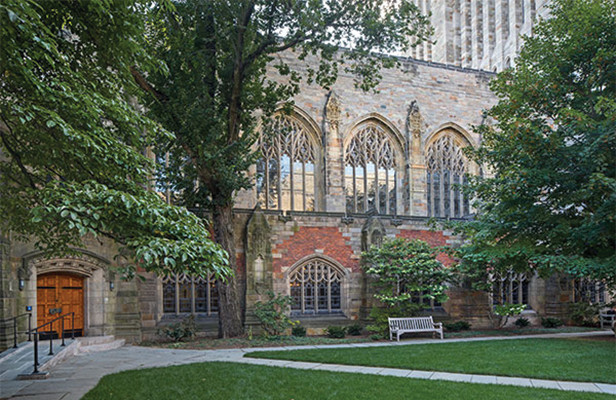
In 2014, Helpern Architects completed what Yale University’s then-Librarian, now Vice Provost Susan Gibbons called the “spectacular renovation” of Sterling Memorial Library’s cathedral-like entry, called the Nave. It was the first complete renovation of Architect James Gamble Rogers’ 1931 Collegiate Gothic masterwork in eight decades and Helpern’s sixth project for Yale.
The Nave, now considered a model of 21st-century library services, not just great “statement architecture,” is a 45-ft-high semi-attached structure that serves as the main library’s public entrance. Helpern Architects’ mandate was to restore the Nave to its original splendor, accommodate and anticipate rapid changes in library use, and make the old and new indistinguishable. Ms. Gibbons also wanted to turn the Nave into “a destination rather than a passageway.”
The Nave is the sole point of entry for students, faculty, researchers, guests at major events, and as many as 17,000 visitors a month, many of them in tour groups. Over 250 people work there, in offices that Helpern Architects renovated as an extension of the contract.
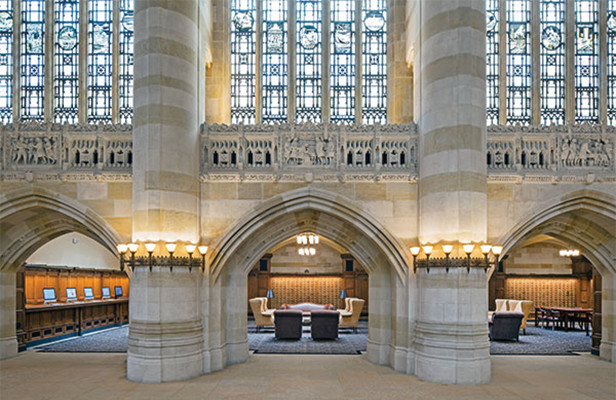
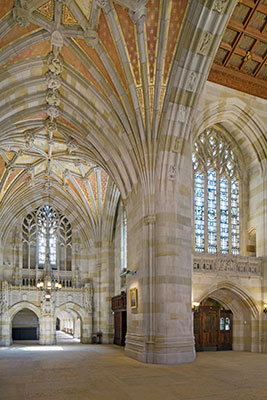
There is a 150-foot-long central space; a two-story-tall mural of Alma Mater [also restored] at the western end; north and south aisles behind eight massive columns; a transept called “The Crossing”; a service-center “sacristy”; 22 stained glass windows, most of them 25’ high, by G. Owen Bonawit; and ornamental metalwork by Samuel Yellin, also a noted artisan of the 1930s.
Inserting new systems: Most to the point, the Nave is a stone-on-stone building – therefore, fundamentally unchangeable – just as a cathedral would have been built. What is NOT visible is key to the success of the project: the new air conditioning system, advanced computer technology [and universal connectivity], state-of-the-art security, access controls, and CCTV. These have been threaded behind wood cabinetry, along raceways on the balconies, within lighting fixtures, and across unutilized space under the roof.
Cleaning, repairing, and relighting: Other intricate work focused on the limestone and sandstone columns, stone floor, vaults and friezes; painted and gilded oak-and-plaster ceilings, extensive metalwork; and stained glass and skylights. Restored and retooled lighting fixtures and new up-lighting have revealed elaborately ribbed, coffered, painted ceilings with their gilded bosses and details.
Updating the interiors: The Nave received new interiors in keeping with the “old/new” mandate. Card catalogues flush to the wall remain as decoration. New cabinetry uses their end pieces to disguise and muffle air-handling equipment. Leather armchairs and leather-topped reference tables lined with computers occupy the space where card catalogues once stood. The original librarians’ service desks moved to the north aisle, while the “Chancel” is now set up for such DIY tasks as scanning and electronic self-checkout. At the entryway, there is a new, custom oval security desk loaded with advanced security equipment.
Praise: The cover story of the November 2014 Yale Alumni Magazine explains how the Nave was recaptured and redefined; it also offers a remarkable panoramic tour of the space. It was also on the cover of Architectural Lighting and Faith and Form, and reported at length by Architect Magazine. The NY Times December 27, 2014 front section exclaimed how Helpern’s renovation “revealed just how spectacular Sterling must have looked when it opened.”
Besides taking honors from AIA New England, the Nave was the sole historic preservation project of the 2015 AIANY Design Awards, out of 35 winners [on 400 submissions]. Its success, the key juror wrote, comes from Helpern’s “astute understanding of the different uses of a library in the 21st Century, as opposed to the 1930s.”